
What the new Income Tax Act, 2025 means for CAs from 1 April 2026
The Income Tax Act, 2025 replaces the 1961 Act on 01/04/2026. A practical note on what actually changes for CA practice in the first quarter of FY 2026-27.
- Income Tax Act 2025
- Budget 2026
- ITR
- TCS
- compliance
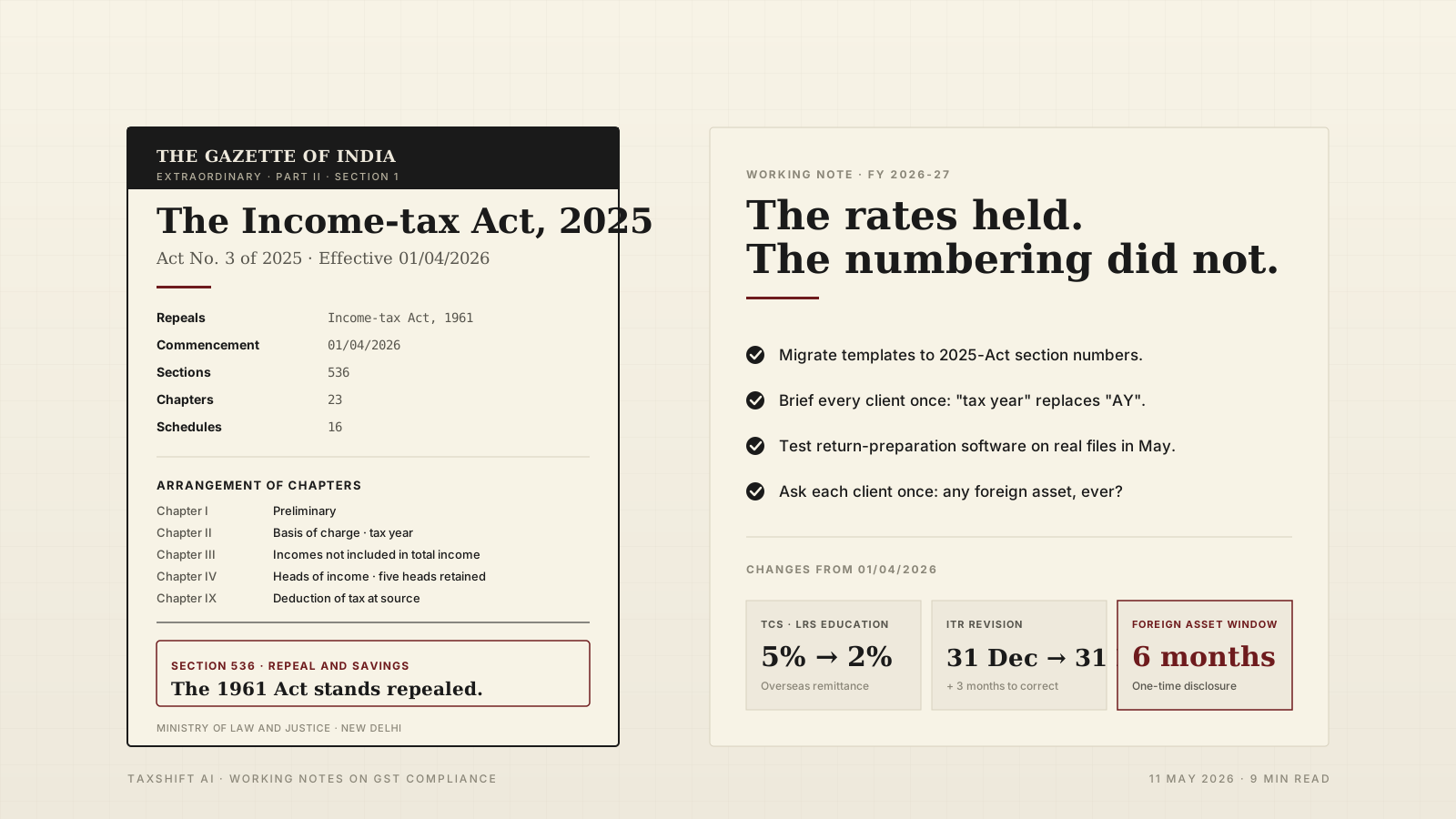
The Income Tax Act, 2025 replaces the Income Tax Act, 1961 with effect from 01/04/2026. The rates and slabs are unchanged. The structure, the numbering, the forms, and the compliance calendar are not. Budget 2026 was tabled alongside the rollover and kept the slabs steady while making specific, client-visible changes to TCS, STT on derivatives, NRI property TDS, the ITR revision window, and foreign asset disclosure. This is a working note on what to actually do about it in the first quarter of FY 2026-27.
1. What replaces the 1961 Act, and what does not
On paper, the Income Tax Act, 2025 is a rewrite, not a reform. The stated goal is clearer language, fewer cross-references, and a more readable structure. The charging provisions, the five heads of income, the residential status tests, and the core anti-avoidance machinery carry forward with renumbered sections.
Structural claims to verify before you cite them to a client:
- Section count reduced.
- Rules and forms reduced.
- Section 536 of the 2025 Act contains the repeal and savings clause.
The practical consequence is that every internal checklist, engagement letter, MRL template, audit working paper, and ITR reconciliation template referencing a 1961-Act section number will point to the wrong place on 01/04/2026. Budget the week of 24 March 2026 to 31 March 2026 for a template migration — not the first week of April.
2. Tax year replaces assessment year
The 2025 Act uses a single "tax year" in place of the "previous year / assessment year" pair.
This is small in substance and large in communication. Every client-facing document — engagement letter, invoice, covering letter, email template — needs the term updated. Every client who still talks in "AY" needs to be told, once, that their accountant now speaks in "tax year" and that the two map cleanly to each other. A one-page briefing sent once in April saves forty explanations across the quarter.
3. TCS rationalisation under Budget 2026
Budget 2026 cut TCS on two LRS-facing categories from 01/04/2026:
- Overseas tour packages: flat 2%, replacing the earlier two-tier structure.
- LRS remittances for education and medical: 2%, down from 5% above the threshold.
Two actions follow. Travel agents, ticketing agents, and education consultants need revised TCS invoices from April; collection and Form 27EQ mechanics continue. Individual clients who front-loaded remittances in March 2026 should confirm with their bank that the rate applied was correct for the date of debit, not the date of quote.
4. STT hike on derivatives
Budget 2026 raised the securities transaction tax on derivatives from 01/04/2026.
For CAs with F&O-active clients, this hits the cost ledger, not the return. STT remains deductible for trader clients reporting F&O income under profits and gains of business or profession. Confirm each client's accounting system picks up the revised rate from the contract note; most broker platforms update overnight, not all back-office tools do.
5. NRI property TDS — PAN-based challan
A resident buyer can now deduct and deposit TDS under Section 195 using a PAN-based challan, without first obtaining a TAN.
Previously, a one-off buyer of an NRI-owned apartment had to apply for a TAN and manage a compliance stack meant for regular deductors. From 01/04/2026 that leg is removed for resident buyers. What has not changed: the obligation to deduct, the application on gross consideration (there is no ₹50,00,000 threshold for NRI sellers, unlike the resident regime), and the advisability of a lower-deduction certificate under the successor to Section 197.
Update your property-transaction SOP to a one-page checklist: "Seller resident? Yes → 1% under the resident-property section. No → gross consideration under the NRI-property section, PAN-based challan, 27Q."
6. ITR revision window extended to 31 March
Budget 2026 extended the revised-return window from 31 December of the assessment year to 31 March, subject to a nominal fee.
The 31 December deadline that shapes December cash-flow for most firms moves to 31 March. The updated-return (ITR-U) regime appears to be carried forward in modified form. Late-filer clients still owe interest under the successor to Section 234A/B/C. Communicate the new window once, in writing, in April — a client who thinks revision is open until March tends to schedule the conversation in February.
7. One-time foreign asset disclosure window
Budget 2026 introduced a one-time disclosure scheme for undisclosed foreign income and assets, aimed at small-taxpayer cases, with a six-month window. Public coverage has called it the Foreign Assets of Small Taxpayers Disclosure Scheme.
Three questions for every file: which clients hold any foreign asset at all — an old US brokerage account, an ESOP from a foreign parent, a foreign bank account opened on deputation, a single foreign mutual fund SIP? Of those, which were reported in Schedule FA? Of the unreported ones, which fall inside the scheme's cap and which outside?
Circulate a single-question email to your entire book in April: "Do you hold, directly or indirectly, any bank account, brokerage account, ESOP, mutual fund, or real estate outside India?" The replies will shape the next six months of practice.
8. ITR forms and the migration week
The ITR form structure is being re-laid to match 2025-Act numbering. Even if the data collected is largely unchanged, schedule numbers, row labels, and the JSON schema will move.
If your firm files from desktop return-preparation software, the first week of the filing season is not when you want to discover that a custom import mapping is broken. Ask your vendor for their testing-release ITR JSON as soon as it is available, import one real client file per ITR type, and find the breakages in May. In-house Excel-to-JSON tools need the same exercise.
The Return Comparison workbook in TaxShift AI produces four sheets per FY from GSTN autoliab and retsum data. CAs reconciling turnover between GST-reported outward supply and the profits shown in the new ITR schedules can use the combined sheet as a single source for the turnover reconciliation working paper.
Summary
The Income Tax Act, 2025 is a rewrite with modest substantive change and broad procedural change. The rates and slabs are the same. The section numbers, the form layouts, the TCS rates, the NRI-property TDS mechanics, and the ITR revision window are not. Plan a template migration in late March, a client briefing in early April, and a software JSON sanity-check well before the first return is filed.