
GST changes from 1 April 2026: what to tell your clients this month
A working note on the GST changes taking effect from 01/04/2026 — new invoice series, export refund threshold removed, tighter ITC ledger, IMS offline tool, RSP-based valuation for tobacco and pan masala.
- GST
- ITC
- invoice management system
- 2026-27
- compliance
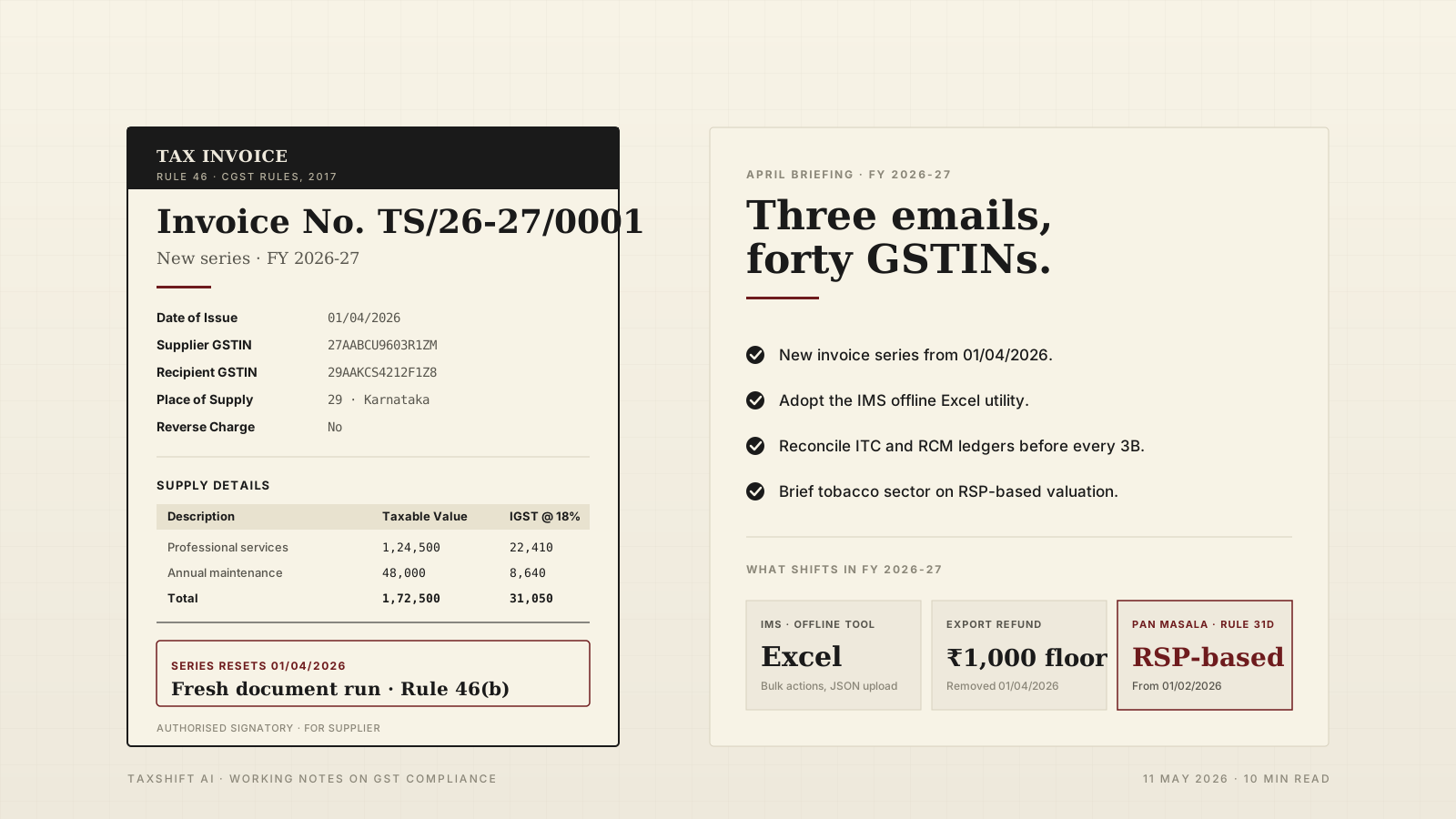
Several material GST changes take effect from 01/04/2026. A few are administrative, several have teeth. The working question for a CA managing a book of GSTINs is not which of these are "important" in the abstract — they are all in the advisory notes — but which of them need to be communicated to the client this month, before the April return cycle. This is that triage.
1. Fresh invoice series from 01/04/2026
Every GST invoice, debit note, and credit note needs a new document series for the new FY. The series must be unique for the financial year and must conform to Rule 46(b) of the CGST Rules — up to sixteen characters, alphanumeric, special characters limited to hyphen and slash.
Practical checklist for every GSTIN:
- Series must start afresh on 01/04/2026. Running last year's series into the new FY is the most common audit finding in a first GSTR-1 of the year.
- Keep the series short. A fifteen-character code cluttered with branch or product codes leaves no room for the sequence number and forces a mid-year reset.
- Debit and credit notes need their own series. A shared counter with invoices is not a violation but complicates reconciliation.
- E-invoice and e-way-bill portals pick up the new series automatically on the first sale; accounting software does not always. Ask every client to raise one dummy invoice on 01/04/2026 and confirm the series is picked up before the first real sale.
For clients with multiple locations under one GSTIN, a two-letter location prefix inside the sixteen-character limit is the cleanest structure. Multiple GSTINs across states run independent series.
2. Export refund: the ₹1,000 floor removed
The threshold for export refund claims has been removed from the CGST Act. Every valid refund claim — however small — can now be processed.
This matters for two client profiles. MSME exporters with low-value shipments each month, previously disqualified by the floor, can now claim. Larger exporters with a long tail of small credit notes can now recover that tail. The operational change is minimal — same RFD-01, same Annexure-B, same documentation. What changes is that the department can no longer use the floor as a reason to reject. Tell MSME exporter clients once, in April, that low-value refund claims are viable.
3. The IMS offline Excel tool
GSTN rolled out an Excel-based offline utility for the Invoice Management System in April 2026. Online IMS — which lets a recipient accept, reject, or keep pending invoices saved by their suppliers before those invoices flow to GSTR-2B — has been live since October 2024. The Excel tool does the same work in bulk, offline, and uploads a JSON of actions back to the portal.
For an accountant processing supplier invoices for forty GSTINs each month, this is the single most useful operational change of the 2026 calendar. The online IMS is row-by-row; the offline Excel takes ten minutes of bulk filtering and produces a JSON that updates the portal in one upload.
How the flow works:
- GSTR-1 / GSTR-1A / IFF records saved by suppliers land in the recipient's IMS. The recipient accepts, rejects, or holds pending.
- Only accepted records populate GSTR-2B. Rejected records are excluded; pending records are carried forward.
- The offline utility lets you export a month of inward IMS data, filter by supplier or pattern, mark actions in bulk, and upload one JSON.
Pair the IMS workflow with the Return Comparison workbook in TaxShift AI. The 2B-vs-3B sheet reads from GSTN's autoliab output, so once IMS actions are locked and 2B is finalised, the comparison surfaces exactly which ITC is available and which is not, without manual arithmetic.
4. Electronic credit reversal and RCM ledger — the hard limits
GSTN tightened validations on the Electronic Credit Reversal and Re-claim Statement and the RCM Liability/ITC Statement at the end of December 2025. The effects carry through the FY 2026-27 cycle and are now default portal behaviour.
The two hard limits:
- Re-claimed ITC in Table 4(D)(1) of GSTR-3B cannot exceed the closing balance of the ITC Reclaim Ledger plus the current period's reversal. If the claim exceeds the balance, GSTR-3B filing is blocked at submission.
- The RCM Liability/ITC Statement cannot show a negative closing balance. If it does, GSTR-3B filing is blocked until reconciled.
Neither is a change in the law. Both are a change in enforcement. Historically, an over-claim was accepted and surfaced a year later at scrutiny under an ASMT-10 or DRC-01A. From 2026 the portal blocks the filing at submission. Monthly reconciliation is the minimum standard. Instruct clients to run both statements before each GSTR-3B; if either closing balance is negative, find the reason before the filing date.
5. RSP-based valuation for tobacco and pan masala from 01/02/2026
This change preceded the April package but belongs in the same FY 2026-27 briefing for any client in the tobacco supply chain. Rule 31D of the CGST Rules, inserted with effect from 01/02/2026, deems the value of supply for specified tobacco goods, pan masala, and related products to be the declared retail sale price (RSP) less the applicable tax.
For CAs with clients in pan masala, gutkha, chewing tobacco, or cigarette manufacturing and distribution, three things change: the transaction value on the invoice is not the value on which GST is computed — the RSP-less-tax is; the invoice must clearly disclose the RSP; and the applicable GST rate and compensation cess apply on the RSP-based value.
Rule 31D is background reading for any client outside the sector. For clients inside, this is the single most important compliance change of 2026, and it affects every invoice from 01/02/2026 onward.
6. GSTR-3B March 2026: the one-day extension
Worth closing the loop on: the GSTR-3B due date for March 2026 was extended from 20 April 2026 to 21 April 2026. The notification was issued on 21 April 2026 after portal technical issues on 20 April 2026.
If you filed in the extended window, keep the portal acknowledgement with the filing-date stamp — an extended due date is only a defence to late-fee scrutiny if the acknowledgement shows the filing fell inside the extension. A separate GSTN advisory on 16 April 2026 flagged incorrect interest calculations in Table 5.1 of GSTR-3B for February 2026 due to the portal not accounting for the minimum cash-ledger balance under Rule 88B(1). Any March or April interest number that looks higher than expected should be checked against a manual calculation before payment.
7. Briefing cadence for a book of forty GSTINs
Split the April communication into three emails.
Week one, to every client: start a fresh invoice, debit note, and credit note series for FY 2026-27; if you export, ask whether low-value refunds are now worth claiming; the IMS offline Excel tool is live.
Week two, to every client with a GSTR-3B filing habit: run the Electronic Credit Reversal and Re-claim Statement and the RCM Liability Statement before every filing. The portal now blocks filings where the math does not match the ledgers.
Week three, only to tobacco, pan masala, or allied-line clients: from 01/02/2026 GST is computed on the declared retail sale price less tax. Every invoice must disclose the RSP. Re-test the billing system now, not at the next filing.
TaxShift AI's Notice Monitoring runs a daily sweep across every GSTIN and surfaces anything new; paired with the Return Comparison workbook, the annual invoice-series carryover and the first-quarter 2B-vs-3B reading sit in one workbook per client.
Summary
The 01/04/2026 GST package is less a single reform and more a stack of tightening validations, one useful tool, and a handful of procedural simplifications. The invoice series reset is universal. The IMS offline tool is a practical win. The ledger hard limits and the RSP-based valuation for tobacco change how specific client files are maintained. Communicate in April; reconcile in May; let the rest of the year run cleanly.